20 flights without bags after Egypt airport strike
May 19, 2013 by admin · Leave a Comment
Egyptian officials say baggage handlers in Cairo’s airport have gone on strike to protest a colleague’s death, leaving passengers on 20 international flights from Europe and Arab countries waiting several hours for luggage.
Airport officials say senior officials from the country’s national carrier are meeting the baggage handlers to hear their demands, which include guarantees of safer working conditions.
The strike started Saturday after a baggage handler who works for EgyptAir died when a conveyer belt used to unload luggage fell on his head. Airport officials say it took more than an hour for the ambulance to arrive at the scene from the airport’s onsite hospital.
Officials spoke anonymously because they were not authorized to brief the media.
The strike by around 60 baggage handlers did not disrupt flights.
‘Rebel’ campaigners announce 3 million anti-Morsi signatures
May 19, 2013 by admin · Leave a Comment
The ‘Rebel’ campaign has collected 3 million signatures denouncing the presidency of Mohamed Morsi, Mai Wahba, a leading member of the campaign, stated on Sunday.
‘Rebel’ is a grassroots movement established late April to register opposition to President Morsi and force him to call early presidential elections by collecting 15 million signatures by 30 June.
The campaign, which launched its activities at the start of May, has been collecting signatures at home and abroad on a daily basis.
On Sunday, campaign members will be collecting signatures in several Cairo neighborhoods including Mattareya, Old Cairo, Hadayek El-Qubba and Manial.
The 6 April Youth Movement, which is part of the campaign, will be collecting signatures outside Faisal metro station in Giza at 1pm, in addition to a number of other governorates.
Rebel campaigners collected signatures at Friday’s anti-Morsi ‘Returning to the Square’ protest.
Leading Muslim Brother Mohamed El-Beltagy on Friday dismissed the campaign as ‘illogical’ and challenged the opposition to form a political party capable of challenging the government via the ballot box.
Egypt to send troops to Sinai to free kidnapped officers
May 19, 2013 by admin · Leave a Comment
Egypt’s defense minister will send a large combat force to Sinai within 48 hours to free seven kidnapped Egyptian servicemen, a source in his office said Saturday.
The decision to send in the troops came after unsuccessful efforts to negotiate the release of the soldiers and police, a senior defense ministry official told Ma’an.
Local Bedouin leaders had been called in to mediate after gunmen ambushed two minibuses in Sinai’s Wadi al-Akhdar early Thursday and kidnapped seven members of Egyptian security forces.
The captors are demanding the release of all suspects arrested on suspicion of attacks in Sinai, including an August attack on the el-Arish police station that killed 16 Egyptian officers, the defense ministry official said.
Egyptian intelligence officers believe the kidnapped officers are held in different locations. Sources in the intelligence services told Ma’an that some locations had been identified and that Egyptian security forces were preparing to attack the areas to free the soldiers.
Border crossing, airport closed
Egyptian security forces closed the airport and seaport in Sinai’s el-Arish on Saturday in protest at the kidnapping of their colleagues.
The Rafah crossing on Gaza’s border remained shut for the second day on Saturday as Egyptian police closed the gates, also in protest at the kidnappings.
Four of the captured servicemen worked at the Rafah crossing, sources at the terminal told Ma’an.
Egypt’s Interior Minister Mohammad Ibrahim dispatched his assistant to Rafah to convince police to reopen the crossing, but police refused to let the ministry official enter the terminal, a Ma’an reporter said.
The minister’s assistant spoke with police at the crossing gates, and the officers told him they would not reopen the border until their colleagues were released.
Maher Abu Sabha, the general director of crossings and borders, said 800 Palestinians were stranded on the Egyptian side of the crossing on Saturday morning.
The number was expected to reach 1,000 by the end of the day. Most travelers are waiting for the crossing to reopen in hotels in el-Arish. They include sick people who had received medical treatment abroad, pilgrims and students who study abroad.
The governor of North Sinai, Abed al-Fatah Harhur, held an emergency meeting with North Sinai security chief Samih Bashadi and security and military officials to discuss the next steps if Egyptian police refuse to reopen the Rafah crossing.
Egyptian forces stepped up a campaign to close tunnels along the border amid concerns the captured servicemen would be smuggled into the Gaza Strip.
Four tunnels were closed on Friday in the al-Sarsoryeh area near Rafah, a Ma’an reporter said. Egyptian security officials told Ma’an that around 15 tons of cement and large quantities of cigarettes were seized from the tunnels.
Egyptian forces closed seven tunnels in the same area on Thursday.
Gaza’s Interior Ministry announced a state of alert along its border with Egypt on Thursday in case the kidnappers tried to smuggle the Egyptian servicemen into Gaza.
Early Thursday, gunmen ambushed two minibuses in Wadi al-Akhdar, between el-Arish and Sheikh Zuweid cities, and kidnapped seven Egyptian servicemen en route to Cairo for their monthly vacation, Egyptian security officials told Ma’an.
Egyptian President Muhammad Mursi on Thursday summoned his defense and interior ministers for crisis talks on the kidnappings at the presidential palace.
A spate of hostage takings, which usually last for no longer than 48 hours, broke out in Sinai after an uprising forced out President Hosni Mubarak in early 2011 and battered his security services.
Islamist militants have exploited the lawlessness and upheaval in the Sinai peninsula to establish a launchpad for increasingly brazen attacks on security forces, a key gas export pipeline and on neighboring Israel.
British girl drowns in Egyptian hotel pool
May 19, 2013 by admin · Leave a Comment
A five-year-old girl from south London has drowned in a hotel pool at an Egyptian resort in Sharm el-Sheikh.
Chloe Johnson, from Forest Hill in south London, died in a water park at the Coral Sea Waterworld hotel while on a family holiday.
Her grandmother told Sky News on Saturday that the family was devastated by her death.
A spokeswoman for the travel company First Choice said: “First Choice can sadly confirm that a child has died while staying at the Coral Sea Waterworld hotel in Egypt. The incident occurred in a pool in the hotel’s water park.
“Our thoughts and condolences are with the family at this extremely difficult time. The British consulate were immediately informed and they are now working with our dedicated resort team in Egypt, to offer every assistance possible to the family in resort.
“In partnership with the hotelier, our resort team are working to understand how the incident occurred, and we will be carrying out a full and thorough investigation. At this time our priority is to provide support to the family.”
A Foreign Office spokesman confirmed the death of a British national and said it was providing consular assistance.
A spokesman said: “We are aware of the death of a British national in Sharm el-Sheikh in Egypt on 17 May. We are providing consular assistance to the family at this difficult time.”
The Coral Sea Waterworld water park had been open for less than three weeks, according to its Facebook page.
Salafists launch another attack on Egypt’s ‘ruling’ Muslim Brotherhood
May 19, 2013 by admin · Leave a Comment
Prominent preachers from Egypt’s ultra-conservative Salafist Call have again lambasted the “ruling” Muslim Brotherhood for their policies that they say contradict with Islamic teachings.
Speaking at a news conference held in the coastal city of Alexandria Saturday, Yasser Borhami — vice president of the Salafist Call — stated that “the Brotherhood does not represent Islam in any way,” citing the performance of the government.
The incumbent Cabinet is under the management of premier Hisham Qandil, who — despite his constant denials — is believed to be loyal to the Brotherhood, having being appointed by President Mohamed Morsi who hails from the powerful group.
Borhami referred to the fact that the tourism ministry had recently extended the licence of cabarets for three years amid a notable deterioration in the hospitality industry since the 2011 revolution.
Borhami believes that such a move starkly contradicts with the ostensible goal of “freeing Jerusalem from Israeli occupation,” which the Brotherhood and its supporters have been recurrently calling for.
“The liberation of Jerusalem will not be achieved by [singing] slogans, but through real change that comes through a genuine will to implement the [Islamic] Sharia of Allah,” Borhami told the press conference.
Directing his speech to the Brotherhood, based on the widespread notion that the Brotherhood is real ruling body of Egypt, and not President Morsi, he said: “You extend the licences of cabarets and then go on satellite channels to say ‘going to Jerusalem, millions of martyrs?’”
Allying with ‘enemies’
Another leading Salafist Call figure, Ahmed Farid, echoed similar sentiments, reiterating the opposing stance of the Salafists on normalising relations with Iran.
He said during the same conference, “They repeatedly say that the Prophet Mohammed is their role model, that the Quran is their constitution, and jihad is their way. But then they ally with Shia, the enemies of Islam.”
While the majority of Muslims are Sunni, Shia represents the second largest Islamic population. The camps have fundamental differences in their respective doctrines, which creates hostility between them.
Salafists have repeatedly voiced opposition to normalising relations with Iran for fear it could lead to the growth of Shia Islam — the state religion of Iran — in Egypt where a Shia population barely exists.
Early in April, Prime Minister Qandil said Iranian tourists were very keen to visit Egypt for religious reasons; for example, to visit the tomb of the Prophet Mohammed’s grandson, Imam Al-Hussein.
On 1 April, more than 50 Iranians — the first official group to visit Egypt for tourism in decades — arrived in Upper Egypt amid tight security. The visit came as part of a bilateral tourism agreement signed in February.
Tourism between the two countries has been almost non-existent since all bilateral relations were severed following Iran’s 1979 Islamic Revolution. Attempts to revive links were never welcomed by Salafists.
“Getting close to Iran is a betrayal of the state,” Farid stated. “Whoever does that is selling his religion for a bunch of dollars.”
“The Brotherhood said that [satisfying] Allah was their purpose, but by experience it turned out that to rule is their real goal.”
Salmonella behind Al-Azhar food poisoning: Health minister
May 18, 2013 by admin · Leave a Comment
Egypt’s Health Minister Mohamed Hamed said that salmonella bacteria was behind the second mass poisoning incident in Al-Azhar University in Cairo.
Hamed said in a press statement on Friday that the final report on the incident revealed that the bacteria contaminated the food, which left 180 students hospitalised on 29 April after eating in the dormitory.
The minister also stressed the importance of the personal hygiene of staff members involved in food preparation.
Earlier, on 1 April, over 500 students were hospitalised with food poisoning after eating on campus, which sparked protests.
Both incidents sparked anger amongst Al-Azhar students who staged demonstrations against what they described as negligence and deteriorating conditions of the university’s dormitories.
Prime Minister Hisham Qandil, in conjunction with Al-Azhar Grand Imam Ahmed El-Tayyeb, ordered that a committee be formed to look into the incidents and reveal their findings in a report.
Ten officials are currently standing trial on charges of culpability in the 1 April mass outbreak of food poisoning.
One killed in clashes between Muslims and Copts in Alexandria
May 18, 2013 by admin · Leave a Comment
One person has died and dozens injured in clashes between Muslims and Coptic Christians in Egypt’s north coast city of Alexandria, the Ahram Arabic news website reported.
Clashes erupted Friday night in Al-Geish Street in western Alexandria, after a fight started between two young men, one Copt and the other Muslim, when the Copt allegedly sexually harassed the latter’s sister. The parties involved in the fight reportedly used Molotov cocktails and machine guns.
The incident left one person, Sherif Sedki Saad, dead by a heart-attack during the clashes, and dozens others injured.
Nasser El-Abd, Alexandria’s investigations director, said that Central Security Forces prevented the crowds from storming into Al-Azraa Church in Al-Geish Street where clashes have been taking place. Security forces have also spread in the area to restore order.
According to Reuters, police arrested eight people after two hours of fighting.
The situation is currently reported to be calm in the area.
Egypt has last witnessed severe sectarian clashes last April in Al-Khosous city in Qalioubiya governorate after Christian children allegedly painted offensive drawings on the wall of an Islamic institute.
In the ensuing violence, which raged for hours, guns were fired and shops and buildings set ablaze, leading to the deaths seven people, including four Christians and two Muslims. The religion of the seventh person has not been confirmed.
Two people were killed and at least 90 injured the next day when unknown assailants attacked mourners outside St Mark’s Coptic Orthodox Cathedral in Cairo where a funeral service was being held for the four Copts killed in Al-Khosous.
Clashes erupt near Tahrir Square between police, unknown civilians
May 18, 2013 by admin · Leave a Comment
Police forces used teargas Friday while confronting dozens of civilians in front of the Semiramis InterContinental hotel just off Tahrir Square, which has witnessed frequent clashes over the past few months.
Crowds mainly consist of young teenagers threw rocks and Molotov cocktails at security forces as two police vehicles pursued them.
Rioters also set tyres on fire and burned wood in the middle of the road to block it. They also blocked the nearby Kasr El-Nile bridge for a while.
There have been intermittent scuffles between unknown civilians and security forces outside the Semiramis hotel, which is located in a street adjacent to the famous square, for the past few months.
Thousands of protesters converged on Cairo’s Tahrir Square on Friday to join a rally in solidarity with the recently-launched “Rebel” campaign, which aims at “withdrawing confidence” from Egyptian President Mohamed Morsi and bringing about early presidential elections.
Some minor scuffles took place in Tahrir but did not involve security forces.
Traffic returned to normal in Tahrir Square by late evening.
North Cairo may face power outages as workers strike
May 18, 2013 by admin · Leave a Comment
Operations at Egypt’s North Cairo Electricity Distribution Company (NCEDC) have been on hold for the fifth day in row due to a sit-in by workers demanding the release of 17 of their colleagues who are currently under arrest.
The workers are threatening to escalate their protest by cutting off electricity to districts of Cairo supplied by the state-run company, protesting worker Ahmed Adel told Ahram Online on Friday.
The company serves more than 3.8 million Egyptians.
Last week, around a thousand workers gathered at the main headquarters of the company in Cairo to protest the management’s decision to remove a 50 percent bonus from their monthly pay cheques.
Security forces attempted to stop the protests, arresting 15 of the workers on charges of blocking the street and damaging public property.
“It was a peaceful protest, and there wasn’t any need for the security forces’ violence against us,” Adel said.
“The police forces arrested 15 people on Monday, then they released three on bail, but they returned two days ago to call five new workers to be questioned.”
According to Adel, thousands of workers in five subsidiaries of NCEDC have showed solidarity with the detained workers, announcing strikes and halting operations of their branches.
“If residents of these districts face electricity blackouts, they won’t find maintence workers who are responsible for fixing failures,” Adel warned.
The workers’ protest has become a dispute with the police, rather than the management, a source within the company’s management, who spoke on condition of anonymity, told Ahram Online.
“The chairman, for his part, vowed that no one would touch the workers’ bonuses and he assigned a lawyer to defend the arrested,” the source said.
No one at the electricity ministry was available for comment.
Over the last two years, Cairo has endured repeated power outages due to fuel shortages. Its expected that outages will continue during the summer as the national electricity grid is estimated to be overloaded by around 2,500 megawatts on rush days and on days that see heat waves.
Egypt’s electricity consumption during the summer is expected to rise to 29,500 megawatts per day, exacerbated by the hot weather and the Islamic holy month of Ramadan in July. Egypt’s daily capacity for generating electricity currently stands at around 27,000 megawatts.
Egyptian workers played a critical part in the protests leading up to the removal of former president Mubarak, but in the two years since the uprising, many have complained of few improvements in their working conditions.
Labour rights advocates accuse President Mohamed Morsi’s government of taking a tough stance on striking workers, by using riot police to break up strikes and arrest strike organisers, and firing or disciplining public sector workers engaged in labour action.
Egypt ‘suffering worst economic crisis since 1930s’
May 17, 2013 by admin · Leave a Comment
Egypt is suffering its worst economic crisis since the Great Depression, a former finance minister of the country and one of its leading economists have warned.
In terms of its devastating effect on Egypt’s poorest, the country’s current economic predicament is at its most dire since the 1930s, Galal Amin, professor of economics at the American University in Cairo, and Samir Radwan, finance minister in the months after Egypt’s 2011 uprising, said in separate interviews with the Guardian.
Since the fall of Hosni Mubarak in 2011, Egypt has experienced a drastic fall in both foreign investment and tourism revenues, followed by a 60% drop in foreign exchange reserves, a 3% drop in growth, and a rapid devaluation of the Egyptian pound. All this has led to mushrooming food prices, ballooning unemployment and a shortage of fuel and cooking gas – causing Egypt’s worst crisis, said Amin, “without fear of making a mistake, since the 30s”.
“Nobody cares about the poor now,” Amin said. During comparable crises in the late 1960s, the mid-70s and the late 80s, Amin and Radwan argued that Egypt’s poorest were variously shielded from absolute hardship either by state subsidies, overseas aid, comparatively low unemployment, or by remittances from expatriates in the Gulf states. But now one in four young Egyptians is unemployed, household remittances are low, and there is a shortage of subsidised goods.
“You are talking about nearly half of the population being in a state of poverty,” said Radwan, a development economist. “Either in absolute poverty or near-poor, meaning that with any [economic] shock, like with inflation, they will fall under the poverty line.” Currently, 25.2% of Egyptians are below the poverty line, with 23.7% hovering just above it, according to figures supplied by the Egyptian government.
For most Egyptians, rising food prices are the most critical problem. Some goods have doubled in price since last autumn – catastrophic for the quarter of families that already spend 50% of their income on food.
For Hoda Goma, a Cairo architect, the situation is having a serious effect on her two eight-year-old sons. “They’re getting worse at school,” she said. “They’re getting ill more often. They have these black patches under their eyes and their teeth have got worse.”
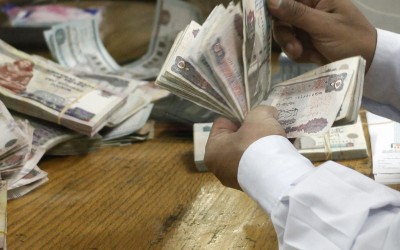
A currency exchange in Cairo. The value of the Egyptian pound has fallen by 12% against the dollar since December. Photograph: Khaled Desouki/AFP/Getty Images
It is down to their diet, Goma explained. She cannot afford to feed them what they need. Six months ago she spent half her salary on food. Now she says it is closer to four-fifths – not because she is earning less, but because rising food prices show no sign of slowing down.
“Prices are on fire,” said grocer Walid Ali. Just last week, Ali would buy a kilo of mandarins for four Egyptian pounds – or 40 British pence – from wholesalers, and sell them for six (60 British pence). “Now I buy them for six and sell them for eight.”
As a result, consumers are either buying less, or not buying at all. “It’s impossible,” said Ali. “I’ve lost half my customers. People can only afford to buy basic foods.” At his two-storey market in central Cairo, the top floor is now entirely empty. Neighbours said all stall-holders on the upper level had been forced to close in recent months.
Inflated food prices are not a new phenomenon in a country that is the world’s biggest importer of wheat, where the population has long risen more rapidly than production, and where up to half of the produce rots in the heat on the way to market. But the recent rate of inflation has been significantly raised by Egypt’s disastrous economic predicament.
Most problematically, the value of the Egyptian pound has fallen by 12% against the dollar since December. For two years, Egypt’s central bank had used its foreign currency reserves to arrest the slide – but with those reserves having shrunk by around 60% since 2011, the bank had to abandon the tactic last winter. As a result, the pound’s value has this year fallen further and faster. In turn, it has become much more expensive to import foreign goods – catastrophic for a country that buys in 60% of its wheat, and whose farmers also often rely on imported fertiliser, fuel and animal feed.
“They have a serious crisis on their hands,” said the EU’s envoy to Egypt, James Moran, who noted that Egypt’s foreign reserves had fallen from $36bn (£24bn) three years ago to $14.4bn last month. “This gives you less than three months’ import coverage – and in an import-dependent economy, this is quite dangerous.”
“We are suffering,” said Ali Eissa, the chairman of Nahdet Misr, a farm company which grows potatoes and oranges on 3,000 acres across Egypt. “It’s impacted most of our fertilisers, machines, tractors – all their prices have dramatically increased.”
The pound’s devaluation has also made it harder for the Egyptian government to import fuel. The state has subsidised diesel (along with goods such as bread, cooking gas and fertiliser) since the dictatorship of Gamal Abdel Nasser. But with those subsidies now accounting for over a fifth of the Egyptian budget, and with a budget deficit of 13%, the state cannot afford to support the population at the level it once did. As a result, there are daily shortages at pumps across Egypt, long queues – and, at times, fatal fights.
“Last month, we couldn’t find any diesel,” said Eissa, who was consequently forced to turn to the black market, where he says fuel prices are between 40% and 80% higher than their legal rate. “The worst thing is that most of the black market quantities are mixed with water – which is breaking a lot of our machines. We have to change the filter, get them maintained, stop the irrigation, stop the tractors.”
The Egyptian president, Mohamed Morsi. Photograph: Eraldo Peres/AP
In turn, farmers must sell their crops for higher prices – and with the government also under pressure to cut subsidies, food is therefore increasingly unaffordable for the poorest Egyptians. “The rich can take care of themselves,” said Karim Abadir, professor of econometrics at Imperial College London, and a co-founder of the Free Egyptians, an opposition party. “But the poor of Egypt are really, really poor. Their daily diet is just bread. First of all, that’s a terrible diet. Secondly, they’re not even going to afford that. And the government has nothing in place to provide them with a safety net when they have to raise prices and cut subsidies.”
So far, Mohamed Morsi’s Islamist-led government has attempted to keep Egypt afloat with short-term measures. It has accepted loans and grants worth more than $5bn from Gulf states such as Qatar, and interest-free fuel handouts from neighbouring Libya. Domestically, it has avoided major economic reforms that might cause short-term upheaval – perhaps fearing bread riots similar to those experienced in 1977, when the then dictator Anwar Sadat first temporarily tinkered with subsidies. Instead, Morsi has focused mainly on meaningless initiatives such as tax rises on peripheral imports such as shrimp and nuts, or closing shops early at night to save electricity. Morsi has also attempted to legalise the controversial sukuk, an Islamist form of government bond that may help to bring in more short-term cash.
“There is no vision, there is no vision whatsoever,” said Radwan of the government’s current economic ministers. The Egyptian finance ministry did not make any official available for interview.
Along with Amin, Radwan said the initial route out of the crisis was obvious. The government needed to take the lead in restoring calm to the polarised Egyptian street and its tumultuous political sphere. National stability would give investors the confidence to reopen the 1,500 factories that have closed since 2011, and encourage tourists – whose spending was once worth $1bn a month to the Egyptian economy – to return.
“Restore stability, restore tourism, and restore confidence from investors,” summarised Amin. Such a process would raise employment, and so lift millions from poverty, gradually allowing the government to end food subsidies for those who would no longer need them.
“It has to be spread over a period of time otherwise the social consequences would be very dire,” said Amin. “As you succeed in raising the income of the poor, you [can] reduce the subsidy.”
The delivery of a much-delayed $4.8bn International Monetary Fund loan – and a further $12bn in contingent loans from the EU and elsewhere – depends on Egypt’s agreement to such reforms. Without the loan, foreign investment – which has fallen by 56% since 2011 – is also unlikely to return.
Radwan said: “I regard the IMF loan, which I was the first to negotiate, and it was turned down, as the key. Not because of the sum. But because if you sign with the IMF, it means you have a sound financial and monetary programme to get you out of the crisis.”
Not everyone agrees. Amin sees the loan as too small to make much difference in itself. Instead, he suggests Egypt should enact the reforms the IMF suggests without taking on the debt itself. “What is the use of this $4.8bn sum?” Amin asked. “It is a big sum, but it still less than what tourism used to bring you. The conclusion is that the loan from the IMF is neither necessary nor sufficient. Not necessary because by attacking the real problems, you can dispense with it – and not sufficient, because if you don’t attack the real problems it doesn’t help you very much. It’s only short-term relief.”
Whatever happens, while politicians prevaricate, ordinary Egyptians are being ever more compromised by the soaring cost of living. Mostafa, a 30-year-old driver, started dealing hashish late last year when his wife became pregnant, realising his monthly earnings of 1,500 Egyptian pounds, or £150, would not be enough to feed his enlarged family. “Without the drug dealing, I would only have 300 Egyptian pounds [£30] to pay for everything after rent and food,” Mostafa said. “How would I be able to support my new children?”
Economists often predict a so-called “revolution of the hungry”, should conditions worsen further. But for Radwan, Egypt is already at that stage: robbery rose 350% in 2012 as Egyptians took wealth redistribution into their own hands. “The elite sits there saying the revolt of the hungry is coming,” said Radwan. “What do you mean it’s coming? Are you waiting for a violent, bloody destruction of the Bastille? It’s already there.”